


Buyer’s Guide
How to Buy a Home in New Jersey: A 6-Step Guide for Buyers
By John Apicella | October 27, 2026
Buying a home in New Jersey is probably the biggest financial decision you will make, and it moves faster than most people expect. Between attorney review, inspection deadlines, and mortgage commitments, the calendar fills up quickly once your offer is accepted. The good news: when you know what is coming, every step feels a lot more manageable.
Our team has walked hundreds of families through this process across Union County and the surrounding towns. Here is the same six-step roadmap we share with our own buyers, updated for how deals actually work in New Jersey today.
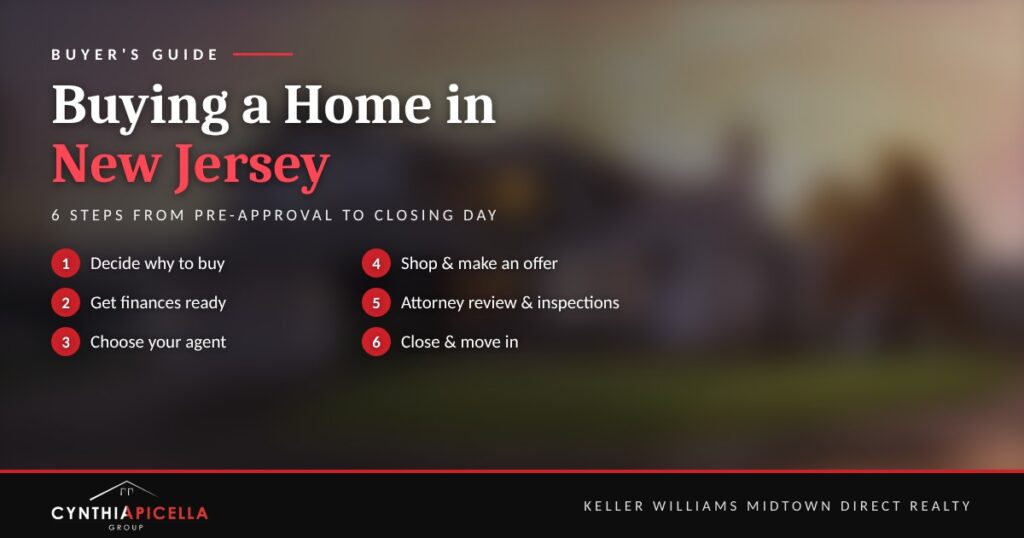
The 6 steps at a glance
- Decide why (and whether) to buy
- Get your finances ready
- Choose the right real estate agent
- Go shopping and make an offer
- Get through attorney review, inspections, and the appraisal
- Close and move in
Step 1: Decide Why You Want to Buy
Before you look at a single listing, get clear on your reasons. Your “why” shapes everything that follows: the towns you consider, the type of home, and how much you should spend.
- Tired of renting? A mortgage builds equity for you instead of your landlord.
- Outgrown your space? Maybe you need another bedroom, a home office, or a bigger yard.
- Want a shorter commute? Proximity to NJ Transit lines and major routes matters a lot here.
- Thinking about investing? A rental property or multi-family can be a long-term wealth builder.
Write your top three priorities down. When you are standing in your fifth open house of the weekend, that list keeps you focused.
Step 2: Get Your Finances Ready
Lenders will want to see a full picture of your finances, so start gathering documents now. Most buyers will need:
- Recent pay stubs and W-2s (or 1099s if you are self-employed)
- Two years of federal tax returns
- Two to three months of bank statements
- Statements for retirement and investment accounts (401(k), IRA, brokerage)
- A list of debts such as auto loans, student loans, and credit cards
- Copies of leases if you already own investment property
Get pre-approved, not just pre-qualified. A pre-qualification is a quick estimate. A pre-approval means a lender has reviewed your documents and pulled your credit from the three bureaus (Equifax, Experian, and TransUnion). In a competitive market, sellers and their agents expect to see a pre-approval letter with your offer.
Budget beyond the purchase price. In New Jersey, property taxes are a major part of your monthly cost, so always ask what a home’s annual taxes are. Also plan for closing costs (attorney fees, title insurance, lender fees, and prepaid items), your down payment, and the deposit you will put down once your offer is accepted.
Keep your finances steady. From pre-approval until closing, avoid changing jobs, opening new credit cards, or financing a car or furniture. Lenders often re-check your credit and employment right before closing.
Not sure where to start? We are happy to introduce you to experienced local lenders.
Step 3: Choose the Right Real Estate Agent
Buying a home means a lot of paperwork, deadlines, and negotiation. A good agent keeps you on schedule, spots problems early, and helps you write an offer that stands out. When you interview agents, ask:
- Are you a full-time agent, and how many buyers have you helped in the towns I am considering?
- How quickly do you respond, and are you available nights and weekends?
- Can I see recent sales or talk with past clients?
- How do you help buyers win in multiple-offer situations?
Expect a written buyer agreement. Before you tour homes, you will sign an agreement with your agent. It spells out what your agent will do for you and how they will be paid. Read it, ask questions, and make sure you are comfortable with the terms.
Most of all, choose someone who listens. You will be talking to this person a lot over the next few months.
Step 4: Go Shopping and Make an Offer
Take a drive. Visit the towns and neighborhoods on your list at different times of day. Check the commute, walk the downtown, and get a feel for the streets you like best.
Narrow your search. Set up listing alerts so you see new homes the day they hit the market, then tour your favorites with your agent. Ask about resale value, recent comparable sales, property taxes, and whether the home sits in a flood zone (which can affect your insurance costs).
Make a strong offer. When you find the one, your agent will look at recent sales and current competition to help you choose a price and terms. Price is only part of it. The size of your deposit, your financing, your inspection terms, and your preferred closing date all matter to a seller.
Step 5: Get Through Attorney Review, Inspections and the Appraisal
Once your offer is accepted, the clock starts. This is the busiest part of the process, and it is where New Jersey differs from many other states.
Attorney review
In New Jersey, when a real estate agent prepares the contract, it comes with a three-business-day attorney review period. During that window, your attorney and the seller’s attorney can review the contract, propose changes, or cancel it. Have a real estate attorney lined up before you make an offer so you do not lose any time.
Your deposit
Your deposit is held in escrow, usually by one of the attorneys or a title company, and is credited toward your purchase at closing.
Home inspection
Schedule a licensed home inspector right away, since your contract gives you a limited window. Depending on the home, you may also want specialized inspections such as radon, a sewer line scope, oil tank sweep, termite, roof, or chimney. If the inspections turn up issues, your attorney can negotiate repairs or a credit with the seller.
Appraisal and mortgage commitment
If you are financing, your lender will order an appraisal to confirm the home’s value supports the loan. Stay in close contact with your lender and send any requested documents quickly so you receive your mortgage commitment on time.
Title, insurance, and HOA approval
A title company will search the property’s records to make sure the title is clear and will issue title insurance. You will also need homeowners insurance before closing; shopping a few quotes and choosing a higher deductible can lower your premium. If you are buying a condo or townhome, request the association’s rules and documents early.
Step 6: Close and Move In
Final walk-through. Shortly before closing, you will walk through the home to confirm it is in the condition you agreed to, any negotiated repairs are complete, and everything included in the sale is still there.
Town requirements. Many New Jersey towns require a resale inspection or certificate of occupancy, and the state requires a smoke alarm, carbon monoxide alarm, and fire extinguisher certificate before a home changes hands. The seller usually handles these, but your attorney will make sure they are in place.
Closing day. In North Jersey, closings typically take place at an attorney’s or title company’s office. You will review and sign the settlement statement and your loan documents, and you will bring your remaining funds by wire transfer or certified check. Always confirm wiring instructions by phone with your attorney or title company using a number you already know; wire fraud targeting home buyers is common.
Set up your utilities. Schedule electric, gas, water, internet, and trash service to start on your closing date. We give every buyer a list of local contacts to make this easy.
Then you get the keys. Congratulations, you are a homeowner!
Ready to Start Your Home Search?
Every purchase has its own twists, and having a team that knows the local market makes a real difference. Whether you are a first-time buyer or moving up, we would love to help you plan your next move. Reach out anytime for a no-pressure conversation about your goals.
Want more detail on any step? Visit our buyer resources: Deciding to Buy, Preparing to Buy, Choose a Real Estate Agent, Time to Go Shopping, Escrow, Inspections and Appraisals, and Moving In.
This article is general information, not legal or financial advice. Talk with your attorney and lender about your specific situation.
John Apicella: 973-885-5953 | john@apicellagroup.com
Team leader Cynthia Apicella: 201-697-5365 | cynthia@apicellagroup.com
Cynthia Apicella Group, Keller Williams Midtown Direct Realty, 223 Mountain Avenue, Springfield, NJ 07081